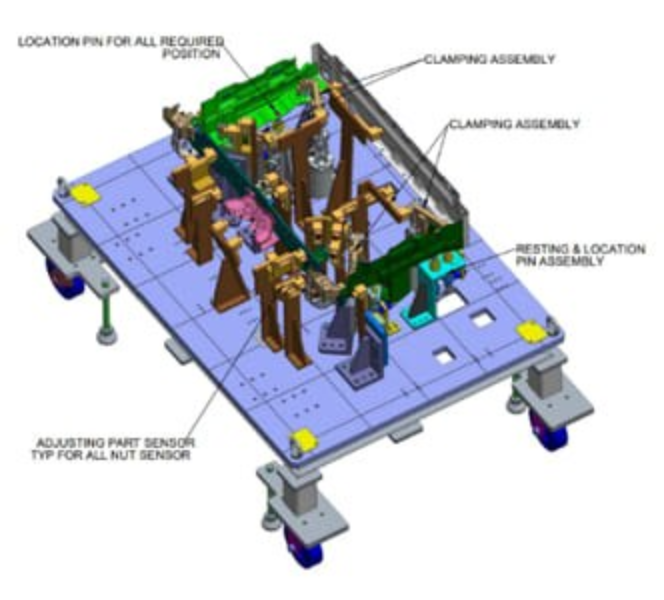
Automated spot welding is widely used where manufacturers need repeatable joining at production scale, particularly in automotive sheet metal assemblies. Yet automation alone does not guarantee dimensional consistency. Robotic Spot Welding Fixtures play a major role in determining how reliably each component is positioned before the robot begins its programmed sequence.
When recurring variation appears in welded assemblies, examining the fixture can reveal issues that are easily overlooked.
Inconsistent component seating is a common problem
A component needs to contact its intended locating points consistently. Burrs, stamping variation, contamination, damaged locators, or unsuitable loading methods can prevent proper seating.
If the fixture clamps a wrongly seated component, the robot may still complete the welding cycle. The dimensional problem then appears during downstream inspection or assembly.
Poka-yoke features, appropriate sensing, and clearly defined locating surfaces can reduce incorrect loading.
Excessive restraint can create distortion
Clamping needs to secure the workpiece without unnecessarily restricting it. Spot welding introduces localized heat, while sheet metal components can already contain variation from stamping and forming operations.
Fixture designers need to consider how the assembly behaves during the complete weld sequence.
Potential improvements can involve reviewing clamp locations, weld sequence, locating strategy, component support, and release sequence.
Accessibility influences cycle efficiency
A fixture can locate a component accurately and still perform poorly if the welding gun cannot reach the required points efficiently.
Design teams need to consider robot and gun access during fixture development. Collision clearance, cable routing, clamp placement, operator loading zones, and maintenance access all affect cell performance.
This is why fixture design benefits from coordination between product, tooling, automation, and production teams.
Wear should be monitored systematically
High-volume fixtures operate through repeated clamp and release cycles. Locators, pads, bushes, pins, and moving mechanisms can gradually wear.
Rather than waiting for assembly rejection rates to rise, manufacturers can establish preventive checks around critical fixture features.
Useful indicators include:
- Changes in locating clearance
- Clamp movement
- Loose mounting elements
- Damaged contact surfaces
- Sensor inconsistencies
- Increased dimensional variation
- Unexpected robot corrections
- Difficulty during loading
Pune's automotive manufacturing network includes OEM facilities, component suppliers, fabrication companies, and automation businesses. For plants operating repetitive welding processes in Maharashtra, fixture condition can therefore have a measurable effect on throughput and quality.
Troubleshooting should examine the complete cell
When weld position changes, the robot programme should not automatically be treated as the only source of error. Production engineers can compare robot repeatability, part variation, fixture condition, locating accuracy, clamp sequence, and weld parameters.
Excellent Tools develops tooling and precision engineering solutions for industrial manufacturing applications in Pune, including requirements where fixture accuracy needs to support automated production.
Well-engineered Robotic Spot Welding Fixtures create a stable physical reference for the welding process. Combined with proper maintenance, sensing, loading practices, and robot programming, they can help manufacturers reduce avoidable production variation and maintain more predictable assembly quality across repeated cycles.
Keywords