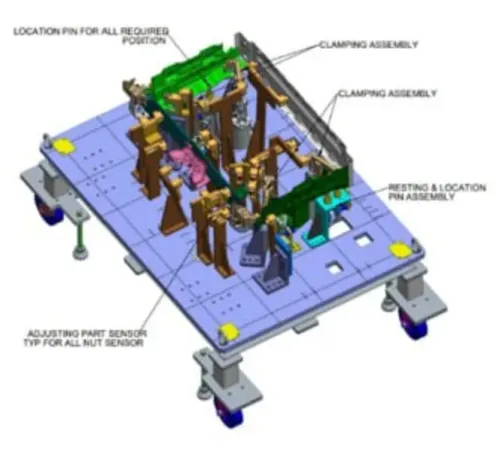

Automation has transformed automotive manufacturing by making production faster, safer, and more consistent. Among the technologies driving this transformation are Robotic Spot Welding Fixtures, which play a vital role in ensuring every weld is performed with precision. While robotic welding systems often receive most of the attention, the fixtures supporting the process are equally important because they accurately position and secure components throughout the welding cycle.
For manufacturers in Pune and across Maharashtra, where automotive and engineering industries continue to expand, investing in properly engineered robotic welding fixtures can significantly improve production quality and operational efficiency.
Why Fixtures Are Essential in Robotic Spot Welding
A welding robot follows a programmed path, but it relies on the workpiece being positioned accurately every time. Even a small variation in part placement can lead to poor weld quality, assembly issues, or rejected components.
Robotic spot welding fixtures are designed to:
- Hold components securely during welding
- Maintain repeatable positioning
- Prevent movement caused by welding forces
- Reduce dimensional variation
- Support faster production cycles
Without reliable fixtures, even advanced robotic systems may struggle to deliver consistent results.
Key Features of High-Quality Welding Fixtures
Not every fixture is suitable for automated production. Well-designed robotic welding fixtures usually include several important characteristics.
Accurate Location and Clamping
Components must be positioned precisely before welding begins. Proper locating pins, clamps, and supports help maintain dimensional consistency throughout production.
Easy Loading and Unloading
Efficient fixture design minimizes operator effort and supports quicker production cycles without compromising safety.
Durability for High Production Volumes
Automotive manufacturing often involves continuous production. Fixtures should be built using durable materials capable of maintaining accuracy over thousands of production cycles.
Compatibility with Automation
Fixtures should integrate smoothly with robotic cells, sensors, conveyors, and automated material handling systems.
Benefits for Automotive Manufacturers
Using well-designed robotic spot welding fixtures offers measurable advantages.
- Improved weld consistency
- Reduced production rework
- Better dimensional accuracy
- Lower rejection rates
- Faster cycle times
- Higher equipment utilization
- Greater operator safety
These improvements contribute directly to better production efficiency and lower manufacturing costs.
Industries Beyond Automotive
Although automotive manufacturing remains the largest user of robotic welding fixtures, similar solutions are increasingly used in:
- Commercial vehicle manufacturing
- Aerospace fabrication
- Agricultural equipment production
- Heavy engineering
- Railway component manufacturing
- Industrial equipment assembly
As automation expands across industries, fixture design continues to evolve to support increasingly complex production requirements.
Choosing the Right Manufacturing Partner
When evaluating suppliers for robotic welding fixtures, manufacturers should consider:
- Experience in fixture design
- Precision machining capabilities
- Understanding of robotic integration
- Quality inspection processes
- Ability to develop customized solutions
- Long-term engineering support
A supplier that understands the complete production process can often recommend fixture improvements that enhance overall manufacturing performance.
Engineering companies such as Excellent Tools develop customized robotic welding fixtures designed to match customer-specific production requirements. Their work in precision engineering and industrial automation reflects the growing demand for reliable manufacturing solutions in Pune's industrial ecosystem.
Final Thoughts
Robotic spot welding is only as reliable as the fixture supporting it. Precision-designed fixtures improve welding quality, production consistency, and manufacturing efficiency while reducing costly errors. As manufacturers continue investing in automation, selecting properly engineered welding fixtures becomes an important step toward achieving dependable, high-quality production.
Keywords