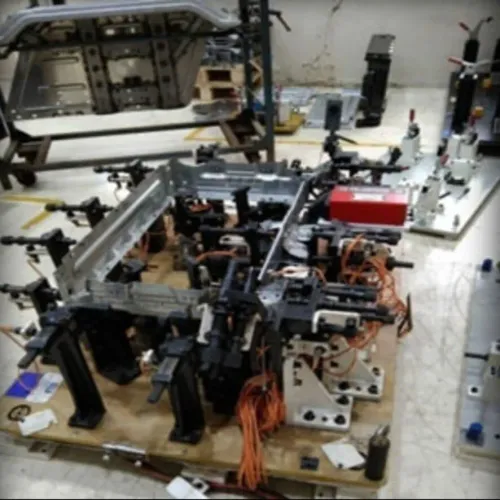
Automotive welding and assembly lines depend heavily on repeatable component positioning. Even an advanced robot cannot compensate for a workpiece that is located incorrectly, clamped inconsistently, or allowed to move during an operation. This is why Robotic Automotive Fixtures are a critical part of automated manufacturing systems.
For automotive OEMs, Tier 1 suppliers, component manufacturers, and production engineers in Pune and across Maharashtra, selecting a fixture provider requires more than reviewing fabrication capability. The supplier must understand component geometry, robotic access, datum strategy, clamping, production sequence, operator interaction, and the realities of a working production line.
Start With the Process Rather Than the Fixture
A robotic fixture should be designed around the manufacturing operation it supports.
Before design begins, engineering teams need to understand what the robot will perform, how components enter the station, which features establish location, and how the completed assembly will leave the fixture.
For a welding application, this may involve studying:
- Component loading sequence
- Weld locations
- Robot approach angles
- Datum points
- Clamping sequence
- Component variation
- Unloading requirements
- Cycle-time expectations
Designing the fixture without understanding these factors can create interference and accessibility problems later.
Check the Datum and Locating Strategy
Repeatability begins with reliable component location.
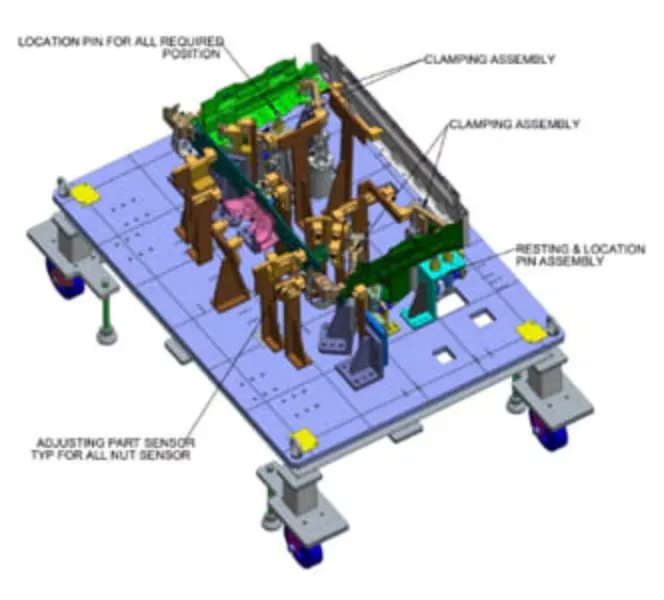
The fixture should establish the workpiece against defined reference points so that each component occupies the intended position during every cycle.
Poor locating strategy can lead to dimensional variation even when clamps and robots operate correctly.
Production engineers should therefore review how the fixture constrains the component and whether the selected locating points correspond logically with the component design and assembly requirements.
Evaluate Clamping Carefully
Clamps need to hold components securely without introducing unwanted movement or distortion.
The appropriate clamping method depends on the component, cycle, automation architecture, and production requirement.
Automated fixtures may use pneumatic or other controlled clamping arrangements. Regardless of the method, engineers need to consider clamping force, accessibility, sequence, reliability, and maintenance.
Thin sheet metal components can be particularly sensitive to inappropriate clamping because excessive force may distort the workpiece before welding even begins.
Robot Accessibility Must Be Verified
A fixture may locate the component perfectly yet still fail in production if it blocks the robot.
Robot arms, welding guns, torches, sensors, and associated equipment require sufficient clearance throughout their movement.
This makes accessibility a major design consideration for Robotic Automotive Fixtures.
Engineering teams should evaluate whether the fixture provides access to all required operation points without introducing unnecessary robot movements.
Restricted access can increase cycle time or force changes to the intended manufacturing sequence.
Consider Weld Spatter and Production Conditions
A fixture used in a robotic welding environment operates under harsher conditions than a general assembly fixture.
Weld spatter, heat, dust, repeated loading, and continuous mechanical movement can affect fixture components over time.
Design decisions should account for these conditions.
Sensors, locating elements, clamps, and moving components should be positioned and protected appropriately where practical. Maintenance access should also be considered because components exposed to production wear will eventually require inspection or replacement.
Look for Error Proofing Opportunities
Production fixtures can do more than simply hold components.
Depending on the application, sensors and interlocks may help verify that the correct component is present, properly positioned, or successfully clamped before the automated operation begins.
This can reduce the likelihood of a robot attempting an operation on an incorrectly loaded assembly.
Error-proofing requirements should be discussed during design rather than added as an afterthought.
Check Whether Maintenance Is Practical
Automotive production equipment may operate across demanding shift schedules. When a fixture needs maintenance, difficult access can increase downtime.
Before approval, consider whether wear components can be inspected and replaced practically.
Locators, bushes, clamps, sensors, cylinders, and other serviceable elements should be accessible according to the maintenance requirements of the system.
Standardisation of suitable replaceable elements may also simplify spare management for plants operating multiple fixtures.
Verify Fixture Accuracy Before Production
Fixture acceptance should involve more than visual inspection.
Critical locating points and functional features need to be checked against the approved design requirements.
Trial assemblies can also help determine whether the fixture performs correctly under realistic operating conditions.
Before production release, teams may need to verify:
- Component loading
- Locating repeatability
- Clamping operation
- Robot clearance
- Sensor functionality
- Completed assembly dimensions
- Unloading
- Cycle suitability
Issues found at this stage are generally easier to correct than problems discovered after the fixture is integrated into regular production.
Choose a Provider With Cross Functional Capability
A robotic fixture project combines mechanical design, precision manufacturing, fabrication, automation understanding, assembly, and testing.
This makes cross-functional engineering capability an important supplier-selection criterion.
Pune is a major automotive manufacturing centre in Maharashtra, with OEMs and component suppliers operating highly automated production environments. Local engineering support can be particularly useful when fixture trials, modifications, line integration, and production improvements require close technical coordination.
Excellent Tools supports precision engineering, fixtures, automation, and custom manufacturing requirements for industrial applications. Automotive teams approaching a new fixture project can improve supplier evaluation by sharing component drawings, CAD data where applicable, datum requirements, robot information, production volumes, cycle targets, and operation sequences.
The best robotic fixture is not simply the strongest structure on the production floor. It is one that positions components repeatably, provides the required robotic access, supports safe operation, simplifies maintenance, and remains practical throughout the intended production programme.
Keywords