Industrial automation can improve production consistency, reduce repetitive manual handling, support higher throughput, and provide better control over manufacturing processes. Yet automation delivers these benefits only when the system is designed around the actual production requirement. Choosing an Automation Tools Manufacturer therefore requires careful evaluation before a project moves from concept to implementation.
For automotive companies, aerospace manufacturers, OEMs, engineering businesses, and industrial plants in Pune and across Maharashtra, several readiness indicators can help determine whether an automation provider is prepared to handle a real production environment.
The Provider Starts With Process Study
A capable automation partner should first understand the existing process.
Immediately recommending robots, sensors, or complex equipment without studying the operation can lead to unnecessary automation.
The initial assessment should consider factors such as:
- Current production sequence
- Component variations
- Production volumes
- Cycle time
- Operator involvement
- Quality checkpoints
- Material movement
- Existing machinery
- Available floor space
- Safety requirements
This information helps identify which parts of the process are genuinely suitable for automation.
The Automation Objective Is Clearly Defined
A project should have a measurable purpose.
One manufacturer may need greater production consistency. Another may want to reduce repetitive handling. A third may need improved cycle time or integration between previously separate operations.
Without a clear objective, it becomes difficult to determine whether the finished system has delivered meaningful value.
Before approving a project, engineering teams should define what problem the automation needs to solve and which performance indicators will be used to evaluate it.
The Provider Understands Mechanical Tooling
Automation is not purely a controls project.
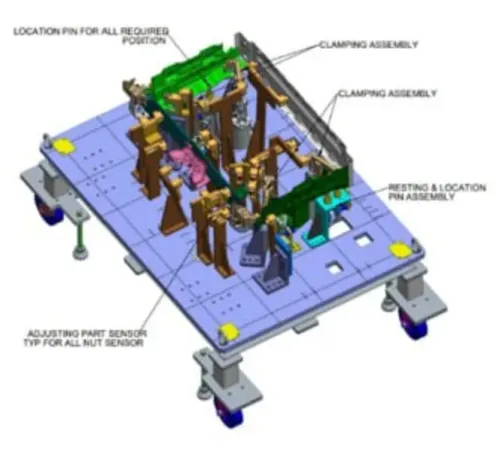
Robots and actuators interact with physical components through fixtures, grippers, locators, clamps, conveyors, and other engineered mechanisms.
If these mechanical elements are inaccurate or unreliable, sophisticated control systems cannot fully compensate.
An Automation Tools Manufacturer with an understanding of precision tooling and fixture design can consider both machine movement and component positioning as part of the same production system.
This is particularly relevant in automotive welding, assembly, machining, and component handling applications.
The Proposed System Accounts for Component Variation
Real production components are rarely identical in every possible characteristic.
Raw material variation, upstream processes, tolerances, and handling conditions can influence how components arrive at an automated station.
Automation needs to accommodate acceptable variation without becoming unstable.
This may involve suitable locating methods, sensor strategies, adjustable tooling, or defined component presentation requirements.
A provider should understand what variation is normal and what should trigger a rejection or process stop.
Safety Is Integrated Into the Design
Safety should be part of the system architecture from the beginning rather than an addition made near commissioning.
Automated equipment can include moving mechanisms, pneumatic systems, electrical equipment, robots, and other potential hazards.
The specific protective measures depend on the application and applicable requirements.
Engineering discussions may need to consider guarding, access control, emergency stopping arrangements, safe operator interaction, and maintenance access.
Production output should never be evaluated independently of safe system operation.
Maintenance Access Has Been Considered
An automated system will eventually require inspection, adjustment, cleaning, or component replacement.
Equipment that is difficult to service can create unnecessary production downtime.
Before approving the design, maintenance teams should review access to items such as:
- Sensors
- Pneumatic components
- Fixtures
- Grippers
- Drives
- Electrical panels
- Replaceable wear parts
Where practical, commonly used industrial components can also simplify spare management.
The Provider Has a Testing Plan
Commissioning should not be the first time the complete system is evaluated.
Where appropriate, automation equipment should undergo testing before installation at the customer's production site.
Testing may verify mechanical movement, sequence logic, component detection, fixture operation, error handling, and cycle behaviour.
Final site conditions still need to be considered, but early testing can identify many issues before production schedules depend on the equipment.
Integration Requirements Are Understood
New automation rarely operates completely independently.
It may need to interact with existing machines, robots, conveyors, inspection stations, plant utilities, or production controls.
The supplier should understand these interfaces before design is finalised.
Incomplete integration planning can result in technically functional equipment that does not fit smoothly into the overall production process.
ROI Is Based on the Whole Process
Automation should not be justified solely by the number of operators associated with a task.
A more complete ROI evaluation may consider production throughput, consistency, rejection rates, rework, downtime, repetitive handling, maintenance costs, and expected equipment utilisation.
For some processes, flexible semi-automation may offer better economics than a fully automated system.
The appropriate level of automation depends on production conditions rather than the assumption that maximum automation is always preferable.
Pune is one of Maharashtra's strongest automotive and industrial manufacturing centres, with plants ranging from large OEM operations to specialised engineering suppliers. This environment creates demand for automation that can be adapted to existing production processes rather than generic equipment packages.
Excellent Tools supports industrial automation, fixtures, precision engineering, and custom manufacturing requirements. Companies preparing an automation project can make the initial engineering discussion more productive by providing component information, current process details, production volumes, cycle expectations, available layout, existing equipment interfaces, and the specific bottleneck they want to address.
A production-ready automation partner should be able to connect mechanical engineering, tooling, controls, safety, testing, and maintainability into one practical system. When those elements are considered together, automation becomes a manufacturing solution built around the process rather than simply another piece of equipment.
Keywords